Jarvis dithering (Jarvis–Judice–Ninke)
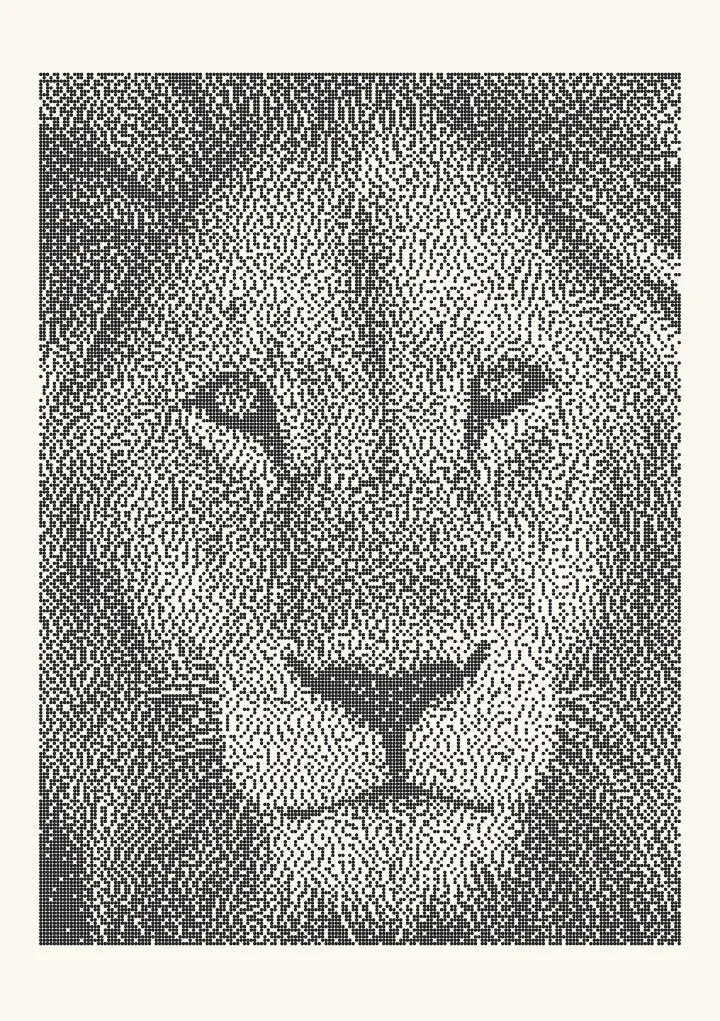
Jarvis, Judice and Ninke spread the error over 12 neighbours and two rows ahead. Tone is smoother and worms are rarer than with Floyd–Steinberg, at the cost of some softness.
Good for photos on lasers.
How it decides
         #  7  5
   3  5  7  5  3
   1  3  5  3  1      ÷ 48
LightBurn’s documentation recommends Jarvis for photos, and it is a safe choice on wood.

Where it comes from
J. F. Jarvis, C. N. Judice and W. H. Ninke published the kernel in 1976, in a survey of ways to show continuous-tone pictures on displays that can only be on or off. It appeared the same year as Floyd–Steinberg, with a much larger kernel: the error goes to 12 neighbours over two rows ahead, with weights of 7, 5, 3 and 1 that fall off with distance, divided by 48.
Why lasers use it
Spreading the error wider smooths tone and breaks up the worm-like chains Floyd–Steinberg leaves in flat areas, at the cost of a slightly softer picture. On a laser, where every burn spreads a little into its neighbours, that softness hardly shows and the smoother tone does, which is why Jarvis is a common choice for engraving photos on wood and leather. It is also slower than Floyd–Steinberg, which only matters for very large images.
Jarvis or Stucki?
Stucki dithering uses the same 12-neighbour shape with weights that give the nearest pixels a larger share, so edges stay a little crisper. Try both on the same photo in the live demo below, or see the whole family side by side in dithering algorithms compared.
Try it live
This runs in your browser. Change the algorithm, the number of cells or the threshold, or put a second algorithm next to it.
Rendered in 0.0 ms on your machine. Every dot here is what a pen or laser would put down.
All algorithms
Every one is an option in the Dither style: dither an image online and export a 1-bit PNG for a laser or SVG dots for a plotter.