Free growth chart SVG files
Free growth chart SVG files for a child’s height board: the marks of a giant ruler in inches or in centimetres, the numerals to go with them, and paint stencils for both. The marks come in sections that fit a 12 inch mat, and each note gives the size that makes them true.
11 designs. Free for personal and commercial use, no sign-up. What you can do with them.
Or choose one below for its PNG, DXF and cutting sizes.
-
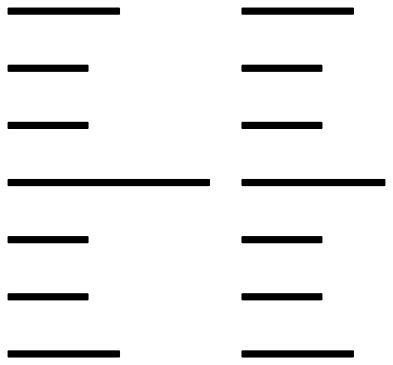 Growth chart inch marks for one foot Solid · 14 pieces
 -
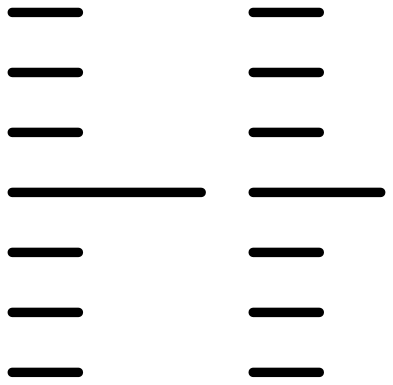 Growth chart marks with round ends Solid · 14 pieces
 -
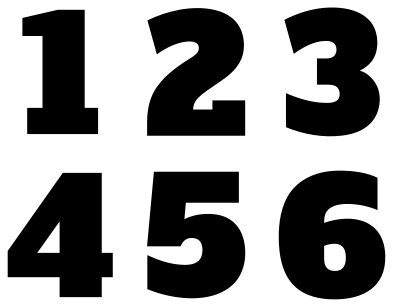 Growth chart numerals 1 to 6 in a slab face Solid · 6 pieces
 -
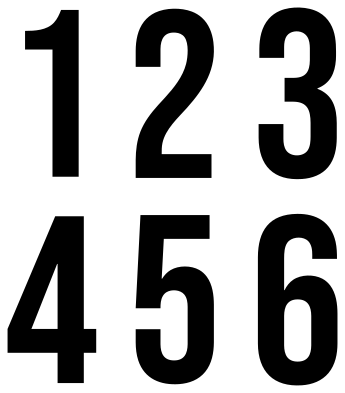 Growth chart numerals 1 to 6, tall and narrow Solid · 6 pieces
 -
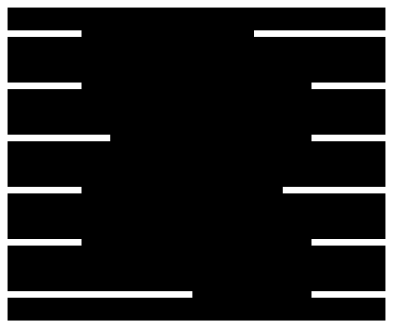 Growth chart stencil for six inches of marks Solid · one piece
 -
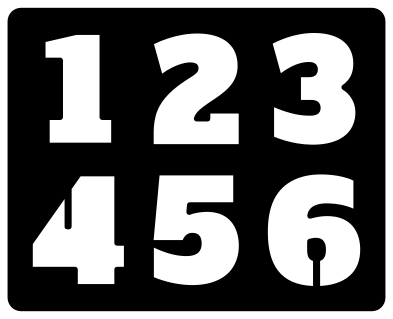 Growth chart stencil for the numerals 1 to 6 Solid · one piece
 -
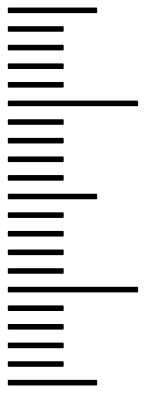 Growth chart marks for 20 centimetres Solid · 21 pieces
 -
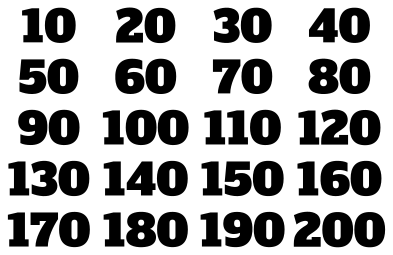 Growth chart numerals from 10 to 200 cm Solid · 51 pieces
 -
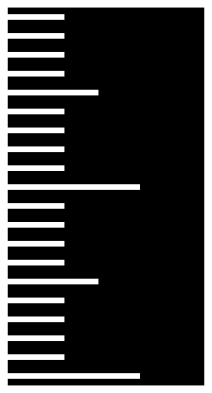 Growth chart stencil for 20 centimetres Solid · one piece
 -
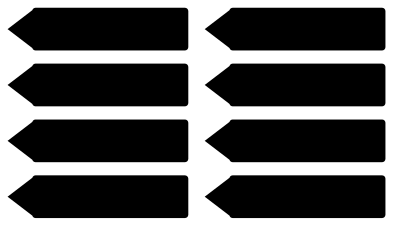 Growth chart marker flags Solid · 8 pieces
 -
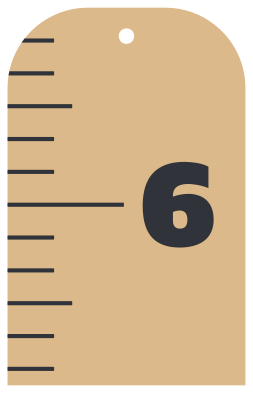 Layered growth chart board with a round top Layered · 13 pieces
Getting the scale true
Every file in the library is published 100 mm on its longer side, so a growth chart has to be scaled up, and the size matters. Each note gives one figure. Set the width or height it names, with the proportions locked, and the marks come out at the real spacing: 25.4 mm for an inch, 10 mm for a centimetre. The inch strips are 168 mm wide and 155.6 mm tall at that size, the centimetre section is 203 mm tall, and all of them fit a 12 inch mat.
Some cutting programs resize a file as they open it. After the first cut, hold a tape measure to the strip: from the first mark to the last should be 152.4 mm, or 6 inches, on an inch strip and 200 mm on a centimetre section, measured between the middles of the marks. Put it right before cutting the rest.
Building a whole chart from sections
A board six feet tall is usually hung with its foot 6 inches above the floor, clear of the skirting board, so it reads from 6 inches to 6 feet 6. The inch file holds two strips. One has a foot line in its middle; the other has a half-foot line. Each strip ends on the mark the next one starts with, so lay that mark exactly over its twin, or weed one of the two away and use the gap as your guide. A six-foot board takes six foot-line strips and seven half-foot strips, the lowest and the highest trimmed to the board. The centimetre sections join the same way, every 20 cm.
Draw a pencil line up the board and measure where each foot line or each ten will fall before anything is stuck down. Then small errors cannot add up along the board. Use permanent vinyl on sealed or painted wood, since it grips bare timber badly. To paint the marks, cut the stencil plates from stencil film or thin card: each plate is exactly as tall as the stretch it paints, so butt it against where the last one ended.
How to open the files
- Cricut Design Space: choose Upload, pick the SVG, and add it to the canvas. Set the width you want; the shape is already welded.
- Silhouette Studio: Designer Edition and above open the SVG. The free Basic Edition does not, so open the DXF instead.
- LightBurn, xTool Creative Space and Glowforge: import the SVG, then set the layer to cut, score or engrave.
- Inkscape, Illustrator and Affinity: open the SVG. It is a plain filled path, so you can recolour it, add a stroke or combine it with your own work.
- Printing or sublimation: use the PNG, which has a transparent background.
Each design page lists the file’s narrowest part at seven sizes, so you can tell whether it will survive at the size you plan to cut.
Questions
Where do the numerals go?
At the end of the long marks, centred on the line. On a board 184 mm wide, which is a 1 by 8 inch plank, the long inch mark is 90 mm and a numeral 64 mm tall and about 54 mm wide fits beside it with room to spare. On the centimetre chart the tens are 70 mm long and their numerals 26 mm tall.
Can I take the chart with me when I move?
That is the reason for marking a board and not the wall. Hang it from one screw or a picture hook, and note how far its foot is from the floor. In the next house, hang it at the same height and every mark is right again.
Why do the centimetre sections begin and end on a five?
So that both tens in a section sit well inside it, with their numerals beside them, and the join falls on a medium mark where a small error shows least. A section is 20 cm long, so a chart that reads from 50 to 150 cm takes five.
 Camera SVG
  Guitar SVG
  Music note SVG
  Stethoscope SVG
  Tooth SVG
  Light bulb SVG