Free pop up card SVG files
Free pop up card SVG templates: sheets with a step, a cake, a skyline, a heart, a sun or a row of tulips that stand up when the card opens, a card in a box, and a version to print. Every cut and every fold is in the file, and each one folds flat.
10 designs. Free for personal and commercial use, no sign-up. What you can do with them.
-
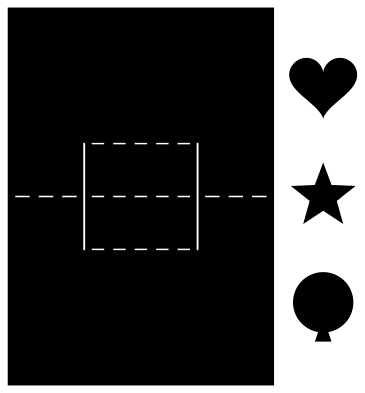 Pop up card base with one step Solid · 4 pieces
 -
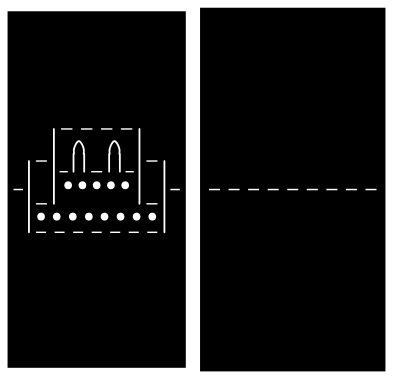 Pop up card with a tiered cake Solid · 2 pieces
 -
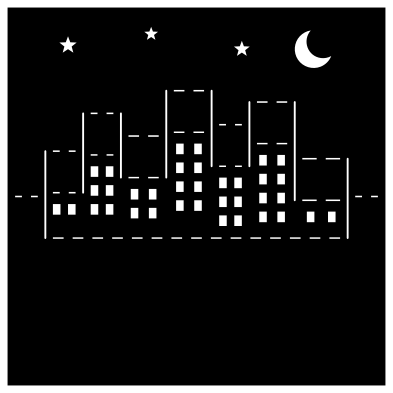 Pop up card with a city skyline Solid · one piece
 -
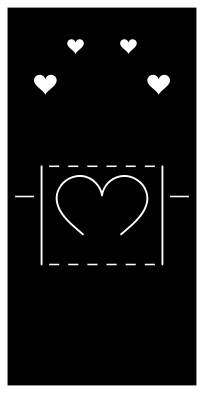 Pop up card with a heart Solid · one piece
 -
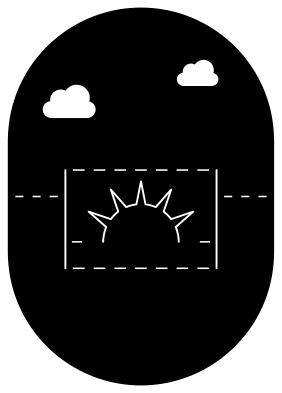 Pop up card with a rising sun Solid · one piece
 -
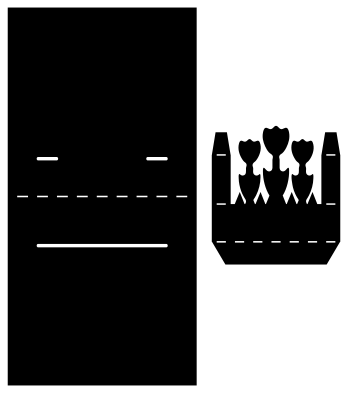 Pop up card with a row of tulips Solid · 2 pieces
 -
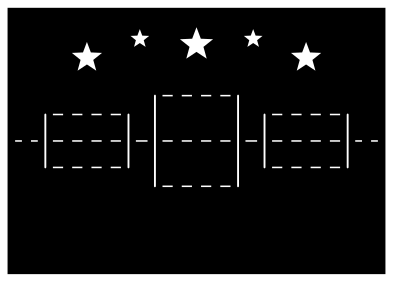 Long pop up card with three steps Solid · one piece
 -
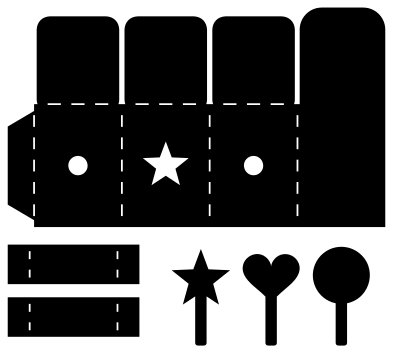 Pop up box card Solid · 6 pieces
 -
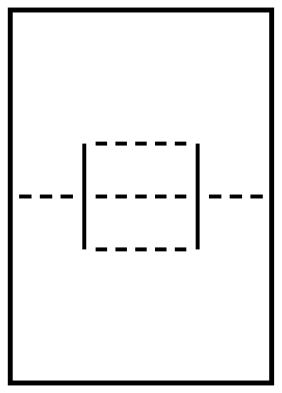 Pop up card template to print and cut by hand Outline · 24 pieces
 -
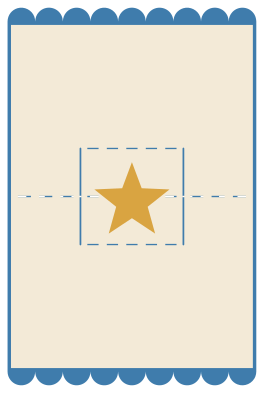 Layered pop up card with a star Layered · 3 pieces
How a pop-up step works
Each pop-up here is a strip of the card itself, cut along its two sides and left joined at its two ends. One end is hinged to the upright half of the card, the wall, and the other to the half that lies on the table, the floor. A third fold between them turns the strip into the top and the front of a box. Open the card to a right angle and the box stands up; shut it and the strip lies flat between the two halves.
It folds flat because the lengths balance. The front of the box is as tall as the distance from the spine up to its hinge on the wall, and the top is as deep as the distance from the spine out to its hinge on the floor, so the strip and the card always form a parallelogram. In these files the fold lines are rows of slits and the cut lines are fine slots, so the blade does all of it in one pass.
Folding and gluing
Fold the spine first, towards you. Then push each strip through from behind and crease its three folds the other way: the two end folds bend like the spine and the middle one bends against it. Close the card and press it flat under a book before you glue anything.
The cuts leave holes in the back of the sheet, so a pop-up sheet is glued into a cover: a plain folded card a few millimetres larger. Put glue on the back of the sheet everywhere except behind the strips, and keep it away from the spine. Use card of 160 to 220 gsm for the sheet, which folds more crisply than heavy card, and 250 gsm or more for the cover.
How to open the files
- Cricut Design Space: choose Upload, pick the SVG, and add it to the canvas. Set the width you want; the shape is already welded.
- Silhouette Studio: Designer Edition and above open the SVG. The free Basic Edition does not, so open the DXF instead.
- LightBurn, xTool Creative Space and Glowforge: import the SVG, then set the layer to cut, score or engrave.
- Inkscape, Illustrator and Affinity: open the SVG. It is a plain filled path, so you can recolour it, add a stroke or combine it with your own work.
- Printing or sublimation: use the PNG, which has a transparent background.
Each design page lists the file’s narrowest part at seven sizes, so you can tell whether it will survive at the size you plan to cut.
Questions
Why will my pop-up not close flat?
Usually because a fold was creased in the wrong place or glue has reached a strip. Each strip must be free of the cover and fold only on its three lines. If you add your own cut-outs to a step, keep them shorter than the space between the step and the edge of the card, or they will stick out when it is shut.
How tall can a cut-out on a step be?
Shut, a step reaches as far from the spine as its height plus its depth. Whatever you glue to its front may stand above it by the distance that is left to the edge of the card. On the one-step base cut 210 mm tall that is 46 mm.
How does the box card fold flat?
The box is a square tube with no base, so it squashes into a flat sleeve along two opposite corners. The cross strips inside are glued to the two side walls and stay parallel to the front, so they fold with it.
 Crown SVG
  Banner SVG
  Bow SVG
  Gift tag SVG
 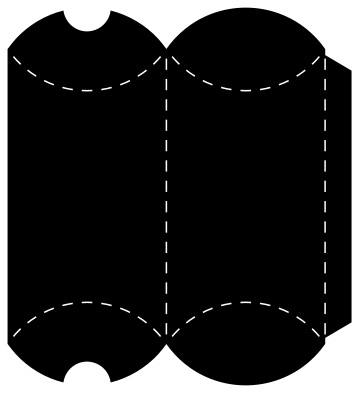 Pillow box SVG
  Gift card holder SVG