Free paper flower SVG files
Free paper flower SVG files that are working templates: a rose, a poppy, a dahlia, an anemone, a sunflower, a daisy, a marigold and a water lily, each with every petal, centre and base it needs on one sheet, and a petal template in four sizes for flowers of your own.
13 designs. Free for personal and commercial use, no sign-up. What you can do with them.
-
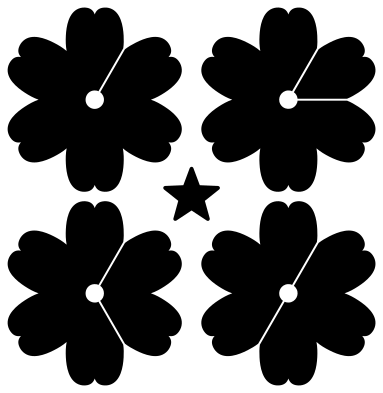 Paper flower rose in four rounds Solid · 8 pieces
 -
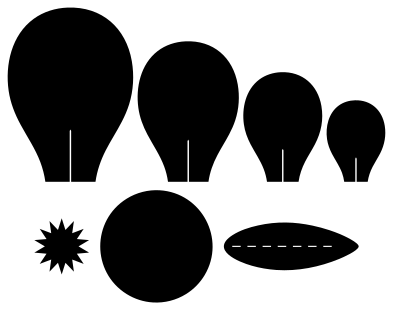 Paper flower petal template in four sizes Solid · 7 pieces
 -
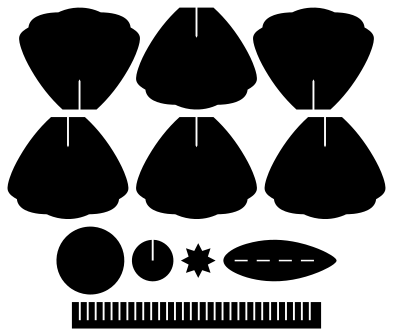 Paper flower poppy template Solid · 11 pieces
 -
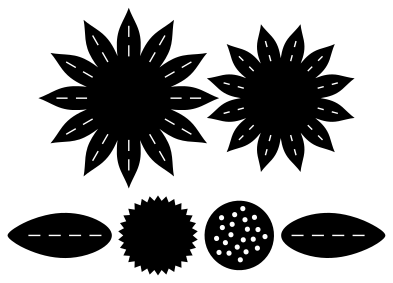 Paper flower sunflower in two rounds Solid · 6 pieces
 -
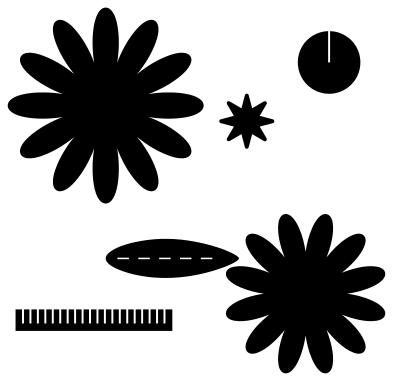 Paper flower daisy with a domed centre Solid · 6 pieces
 -
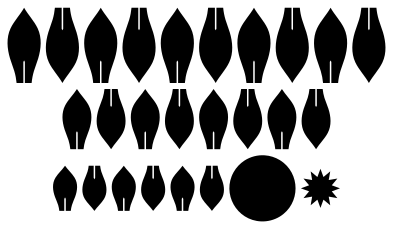 Paper flower dahlia with 24 petals Solid · 26 pieces
 -
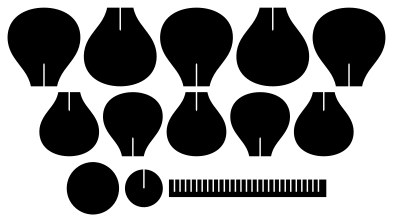 Paper flower anemone template Solid · 13 pieces
 -
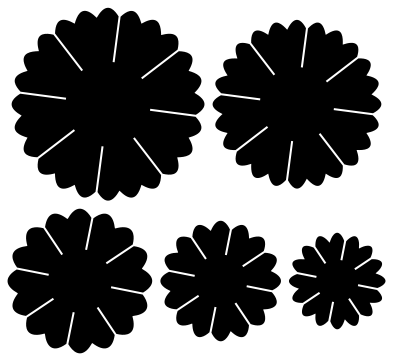 Paper flower marigold in five ruffs Solid · 5 pieces
 -
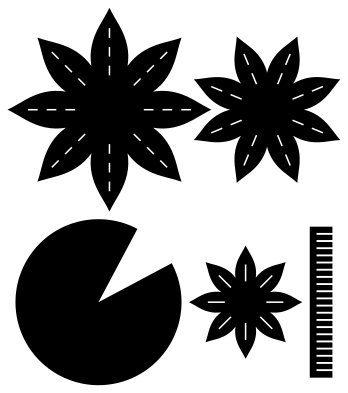 Paper flower water lily on a pad Solid · 5 pieces
 -
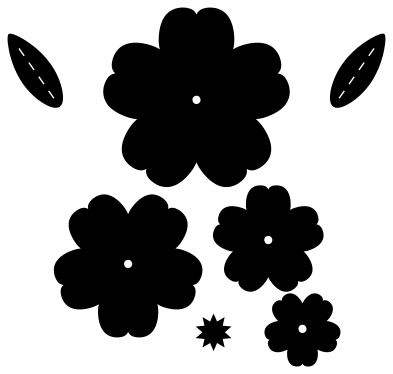 Paper flower blossom in four layers Solid · 7 pieces
 -
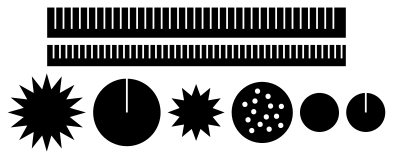 Paper flower centres and stamens Solid · 8 pieces
 -
 Paper flower petals to print and cut by hand Outline · 11 pieces
 -
 Paper flower seen from above in five colours Layered · 5 pieces
How the petals become a flower
Two kinds of piece do the work. A loose petal has a short slit in its foot: pull one side of the slit over the other by about a third of the slit’s length, glue it, and the flat petal turns into a shallow scoop. Glue the feet of the largest petals round the edge of the base circle with their tips outwards, then each smaller size inside the last, set over the gaps. Lap the inner petals a little further and they stand up more, which closes the middle of the flower.
A round is a ring of petals joined at a hub. Curl the petals over a pencil or pinch them along the fold line cut down each one, then stack the rounds from large to small, each turned to cover the gaps in the one below. The rose is the exception: its rounds are cut into pieces of six, five, four, three, two and one petal, and each piece is glued into a cone by lapping its last petal over its first. The cones get steeper as they get smaller and sit one inside the other.
Sizes, card and glue
The files are 100 mm on their longer side, so scale them up before cutting. Each note gives the flower’s size at a cut size that fits a 12 inch mat or a sheet of A4 or Letter card. A flower made from slit petals comes out a little under twice as wide as its largest petal is tall; a stacked flower is as wide as its largest round.
Card of 160 to 220 gsm holds a curl and a scoop. Thinner paper droops, and anything over 250 gsm cracks when the slit is lapped. Coloured-core card hides the cut edges. Hot glue grabs fastest; tacky glue gives time to adjust and leaves no strings. Fold lines are cut as rows of short slits, so nothing needs scoring.
How to open the files
- Cricut Design Space: choose Upload, pick the SVG, and add it to the canvas. Set the width you want; the shape is already welded.
- Silhouette Studio: Designer Edition and above open the SVG. The free Basic Edition does not, so open the DXF instead.
- LightBurn, xTool Creative Space and Glowforge: import the SVG, then set the layer to cut, score or engrave.
- Inkscape, Illustrator and Affinity: open the SVG. It is a plain filled path, so you can recolour it, add a stroke or combine it with your own work.
- Printing or sublimation: use the PNG, which has a transparent background.
Each design page lists the file’s narrowest part at seven sizes, so you can tell whether it will survive at the size you plan to cut.
Questions
How many petals do I cut?
For each named flower, cut the sheet once: it holds the whole flower. For the petal template, cut six of each of the two larger sizes and five of each of the two smaller, with one base circle and one centre.
How far do I overlap the slit?
About a third of the slit’s length at the foot of the petal. Less gives a flatter, more open flower such as a poppy; more makes the petal stand up, which suits the inner rings of a rose or a peony.
Can I make these in felt or crepe?
Felt works for the slit petals and the stacked rounds, glued with hot glue; skip the fringes, which are too fine for it. Crepe paper stretches instead of holding a scoop, so use the print and cut version as a pattern and shape the petals by hand.
 Flower SVG
  Sunflower SVG
  Butterfly SVG
  Rose SVG
  Daisy SVG
  Leaf SVG