Free jaguar SVG files
Free jaguar SVG files of the animal itself: walking, standing, sitting, stalking and leaping, resting on a branch and walking in a ring of leaves, with a head in profile, a face, a paw print, a disc of its spots, an outline and a layered version in three colours.
13 designs. Free for personal and commercial use, no sign-up. What you can do with them.
Or choose one below for its PNG, DXF and cutting sizes.
-
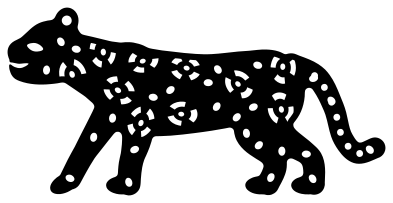 Walking jaguar with rosettes Solid · one piece
 -
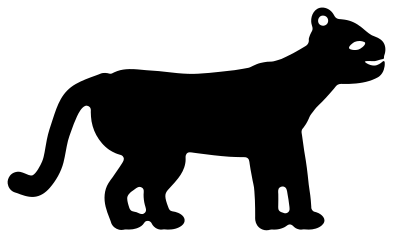 Jaguar silhouette Solid · one piece
 -
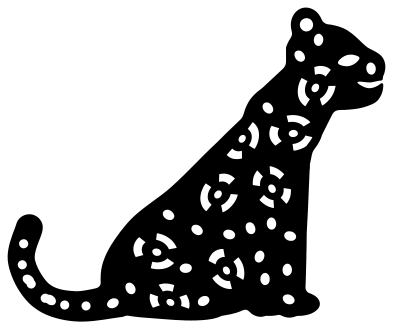 Sitting jaguar Solid · one piece
 -
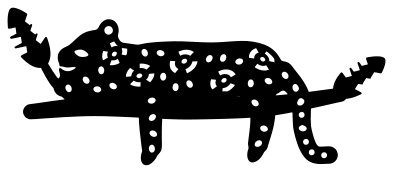 Jaguar resting on a branch Solid · one piece
 -
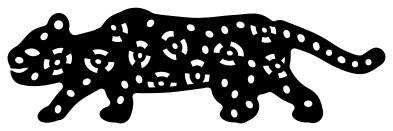 Stalking jaguar Solid · one piece
 -
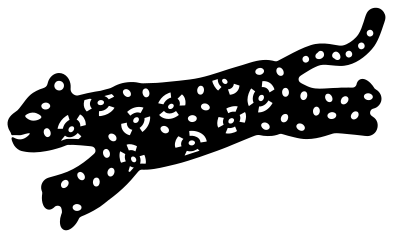 Leaping jaguar with rosettes Solid · one piece
 -
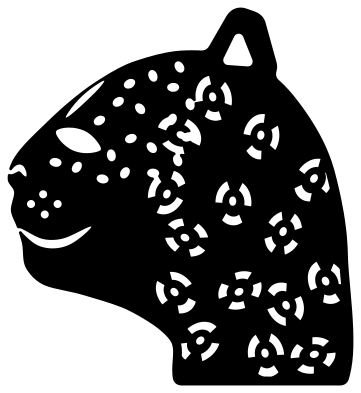 Jaguar head from the side Solid · one piece
 -
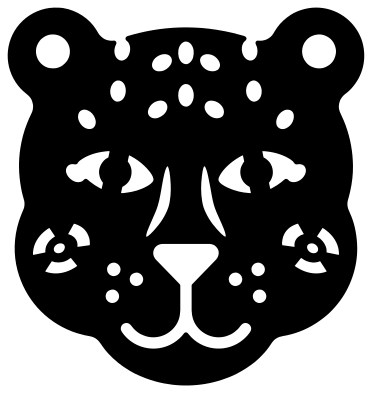 Jaguar face Solid · one piece
 -
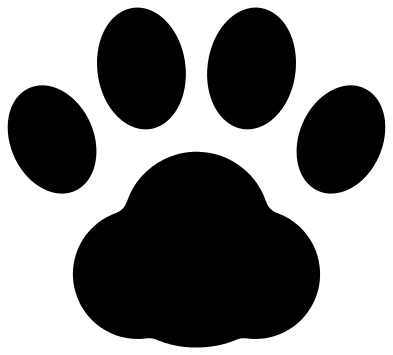 Jaguar paw print Solid · 5 pieces
 -
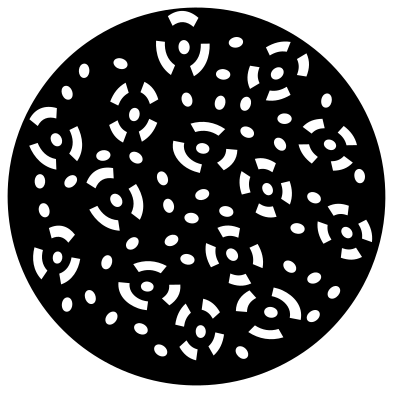 Jaguar spots in a circle Solid · one piece
 -
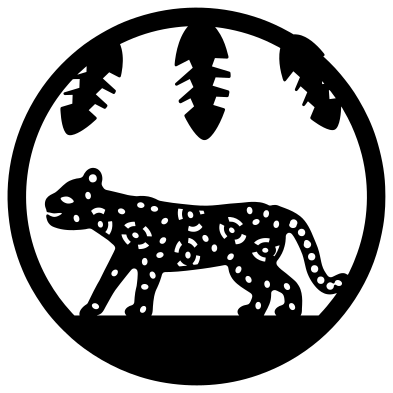 Jaguar in a ring under jungle leaves Solid · one piece
 -
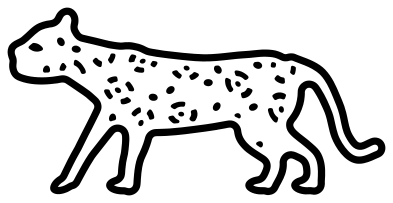 Jaguar outline with rosettes Outline · 48 pieces
 -
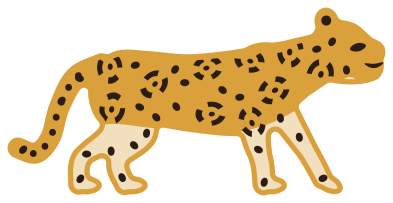 Layered jaguar in three colours Layered · 79 pieces
What makes it a jaguar and not a leopard
The two cats are easy to confuse, and the differences are what these files are drawn from. A jaguar is the heavier animal: a deep chest, short thick legs, a broad head with strong jaws and a tail shorter than its body. Its rosettes are larger and fewer than a leopard’s, and most of them have one or more small spots inside the ring, which a leopard’s do not. Here each rosette is a ring broken into three or four blotches with one spot in the middle, cut as holes, with plain dots on the legs, head and tail.
Jaguars live in the Americas, from Mexico to northern Argentina, and are at home in water and in trees, which is why one of them rests on a branch and one walks under jungle leaves. These are drawings of the animal only: no emblem, no mascot and no lettering.
Cutting a spotted coat
Every file is 100 mm on its longer side. The blotches of a rosette are about 1.7 mm wide at that size and the paper left between two marks is as little as 1 mm on the spotted cats, so cut those at 150 mm or more in vinyl and weed slowly, lifting the film away from the small spots. For wood, engrave the coat instead of cutting it, or use the jaguar silhouette, which has only an eye, an ear and a mouth cut into it and nothing narrower than 1.9 mm.
The spots are holes, so the colour underneath is the colour of the coat. Black vinyl on a tan shirt gives a golden jaguar with dark rosettes reversed; for the true colours use the layered version, with the dark marks laid over a golden body.
How to open the files
- Cricut Design Space: choose Upload, pick the SVG, and add it to the canvas. Set the width you want; the shape is already welded.
- Silhouette Studio: Designer Edition and above open the SVG. The free Basic Edition does not, so open the DXF instead.
- LightBurn, xTool Creative Space and Glowforge: import the SVG, then set the layer to cut, score or engrave.
- Inkscape, Illustrator and Affinity: open the SVG. It is a plain filled path, so you can recolour it, add a stroke or combine it with your own work.
- Printing or sublimation: use the PNG, which has a transparent background.
Each design page lists the file’s narrowest part at seven sizes, so you can tell whether it will survive at the size you plan to cut.
Questions
Which jaguar is easiest to cut small?
The jaguar silhouette and the paw print. The silhouette has three small cuts and holds at 40 mm long; the paw print is five solid pads with nothing inside them and works down to 15 mm. The spotted jaguars need 150 mm or more for the rosettes to weed cleanly.
Can I use the jaguar spots as a pattern on another shape?
Yes. The disc of jaguar spots is one piece with every mark cut through it. Lay any shape over it in your cutting software and intersect the two, or cut the disc from a dark colour and back it with tan for a patch of coat.
How do I stack the layered jaguar?
Golden coat first, then the pale underside on the chest, belly and inner legs, then the dark rosettes, dots and eye. The top layer is many loose pieces, so cut it last, weed away the waste and move it across in one go on transfer tape, using the outline of the coat to line it up.
 Owl SVG
  Bird SVG
  Cat SVG
  Dog SVG
  Elephant SVG
  Fish SVG