Free giant flower SVG files
Free giant paper flower SVG templates for backdrops, nursery walls and shop windows: petals for a rose, a peony, a dahlia, a daisy, a sunflower and a poppy in graded sizes, with the base disc, centres and leaves that finish them. Each petal fills a sheet of card.
10 designs. Free for personal and commercial use, no sign-up. What you can do with them.
-
 Giant flower rose petals in three sizes Solid · 3 pieces
 -
 Giant flower peony petals in four sizes Solid · 4 pieces
 -
 Giant flower dahlia petals in five sizes Solid · 5 pieces
 -
 Giant flower daisy petals and centre Solid · 5 pieces
 -
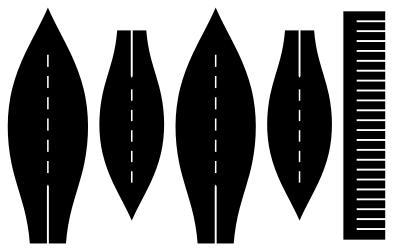 Giant flower sunflower petals with a fold Solid · 5 pieces
 -
 Giant flower poppy petals Solid · 4 pieces
 -
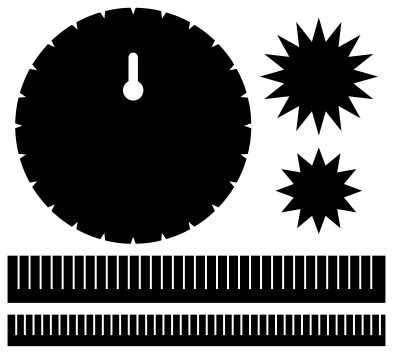 Giant flower base and centres Solid · 5 pieces
 -
 Giant flower leaves in two sizes Solid · 3 pieces
 -
 Giant flower petal to print and cut by hand Outline · 2 pieces
 -
 Giant flower rose seen from above Layered · 4 pieces
How a giant flower goes together
Every petal has a slit running up from its foot for a quarter to a third of its height. Pull one side of the slit over the other by about a third of the slit’s length and glue it: the flat petal becomes a scoop. Glue the feet of the largest petals round the edge of the base disc, tips outwards, using the notches to space them. Then glue each smaller size inside the last, each petal over a gap, and finish with a centre. Curl the top edge of each petal back over a rolling pin before you glue it for a softer flower.
The flower comes out a little under twice as wide as its largest petal is tall. Lap the slits further and the petals stand up more, which makes a deeper, narrower flower; lap them less for a flat, open one.
Sizes, card and hanging
The files are 100 mm on their longer side and hold one petal of each size, so scale the file to the width given in the note, ungroup it, and cut each size as many times as the note says. At those widths the largest petal fits a sheet of A4 or Letter card and a standard cutting mat. For a larger flower, scale up until the largest petal fills a 12 inch sheet.
Card of 170 to 220 gsm suits petals 200 to 300 mm tall: lighter paper droops from a wall, and heavier board will not take the lapped slit without creasing. Hot glue is the usual choice because a giant flower has to hold its own weight at once. The base disc has a keyhole for a nail or a hook; a removable adhesive strip on the back of the disc also holds a flower of this size.
How to open the files
- Cricut Design Space: choose Upload, pick the SVG, and add it to the canvas. Set the width you want; the shape is already welded.
- Silhouette Studio: Designer Edition and above open the SVG. The free Basic Edition does not, so open the DXF instead.
- LightBurn, xTool Creative Space and Glowforge: import the SVG, then set the layer to cut, score or engrave.
- Inkscape, Illustrator and Affinity: open the SVG. It is a plain filled path, so you can recolour it, add a stroke or combine it with your own work.
- Printing or sublimation: use the PNG, which has a transparent background.
Each design page lists the file’s narrowest part at seven sizes, so you can tell whether it will survive at the size you plan to cut.
Questions
How many sheets of card does one flower take?
One sheet for each large and each medium petal, and one for every two small ones. The rose, with seventeen petals, takes fifteen sheets of A4 or Letter card, plus one for the base and centre.
How big should the base disc be?
A little wider than twice the length of the slit in your largest petal, so that the whole lapped foot sits on it. For a petal 250 mm tall that is about 160 mm across, which is the size the base in this set is drawn for.
Can I cut the petals by hand?
Yes. Print the outline version at full size, cut it out, and draw round it on folded card to cut two or three petals at a time. Cut the slit last, straight up from the middle of the foot.
 Flower SVG
  Sunflower SVG
  Butterfly SVG
  Rose SVG
  Daisy SVG
  Leaf SVG