Free water splash SVG files
Free water SVG files: a splash crown, splashes to either side, a drop and its rings, a paint splat, a ring frame and a corner, and water from a tap, a bucket, a fountain and a puddle. There is a leaping fish, a wet dog and a whale’s tail. SVG, PNG and DXF, in one colour or in five blues.
22 designs. Free for personal and commercial use, no sign-up. What you can do with them.
Or choose one below for its PNG, DXF and cutting sizes.
-
 Water splash crown Solid · 19 pieces
-
 Water splash thrown to the right Solid · 15 pieces
-
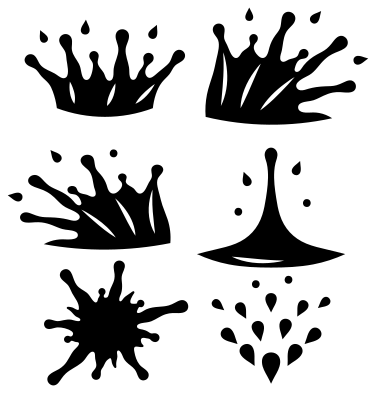 Six water splashes Solid · 32 pieces
-
 Water drop and its rings Solid · 15 pieces
-
 Rain boots splashing in a puddle of water Solid · 13 pieces
-
 Garden tap with a drop of water Solid · 6 pieces
-
 Bucket of water thrown Solid · 15 pieces
-
 Watering can with a fan of water Solid · 20 pieces
-
 Water fountain with two bowls Solid · 8 pieces
-
 Ice cube splashing into a glass of water Solid · 14 pieces
-
 Fish leaping from a splash of water Solid · 14 pieces
-
 Dog shaking off water Solid · 19 pieces
-
 Whale tail in a splash of water Solid · 14 pieces
-
 Paint splash in one piece Solid · one piece
-
 Water splash ring frame Solid · 9 pieces
-
 Water splash corner Solid · 14 pieces
-
 Name panel with a water splash Solid · 12 pieces
-
 Water drop with a mountain river Solid · 6 pieces
-
 Halftone water drop Solid · 4 pieces
-
 Water splash outline Outline · 18 pieces
-
 Water pattern tile of ripples Solid · one piece
-
 Layered water splash in five blues Layered · 35 pieces
Cutting splashes
A splash is a solid sheet that breaks into fingers and then into drops, so most of these designs are one large piece with a dozen small ones round it. In vinyl, put the transfer tape on before you weed the last of the drops and they keep their places. The smallest drops are about 2 mm across when a design is 100 mm wide, so cut at 100 mm or more, or leave the smallest out. Fingers narrow to between 1 and 2 mm behind their beads, which is strong enough for card from about 150 mm.
For wood, acrylic or a paper stencil choose the pieces that hold together: the paint splash, and the drop with a river in it and the panel without their loose pieces. Deleting loose drops never leaves a hole.
Where water looks right
On a tumbler or a water bottle, set a splash so that its foot sits on the real water line or on the base, and let the drops climb. The corner goes on tiles, mirrors and planner pages; mirror it for the other three corners. The ring frame suits swim team names and pool signs at 150 mm or more. Pale blue, white and frosted vinyl read as water on almost anything. On white, use navy or a clear mid blue rather than black.
How to open the files
- Cricut Design Space: choose Upload, pick the SVG, and add it to the canvas. Set the width you want; the shape is already welded.
- Silhouette Studio: Designer Edition and above open the SVG. The free Basic Edition does not, so open the DXF instead.
- LightBurn, xTool Creative Space and Glowforge: import the SVG, then set the layer to cut, score or engrave.
- Inkscape, Illustrator and Affinity: open the SVG. It is a plain filled path, so you can recolour it, add a stroke or combine it with your own work.
- Printing or sublimation: use the PNG, which has a transparent background.
Each design page lists the file’s narrowest part at seven sizes, so you can tell whether it will survive at the size you plan to cut.
Questions
How do I make a splash look wet?
Keep the lights. The thin openings that run up into the fingers show the surface below, and the eye reads them as shine. In the layered crown the palest sheet does that work, so cut it from white or from mirror card.
Can I use the paint splash for real paint colours?
Yes, it is one solid piece, so cut it several times in different colours and let the arms overlap. Turn each copy by a third of a circle and the arms will not fall on top of each other.
How do I tile the ripple pattern?
Set copies edge to edge, all the same way up and with no gap. A ripple that runs off the right side of one copy goes on at the left of the next, and none crosses the top or the foot, so the rows keep their spacing across every join.
 Flower SVG
 Sunflower SVG
 Butterfly SVG
 Rose SVG
 Daisy SVG
 Leaf SVG