Free science SVG files
Free science SVG files: a beaker, a conical flask, test tubes in a holder, an atom, a DNA double helix, a microscope, a horseshoe magnet, a telescope, an exploding experiment and a flask to hold a monogram. The glass is drawn thick and the liquid solid, so each design lifts in one piece.
15 designs. Free for personal and commercial use, no sign-up. What you can do with them.
-
 Science lab glassware Solid · one piece
 -
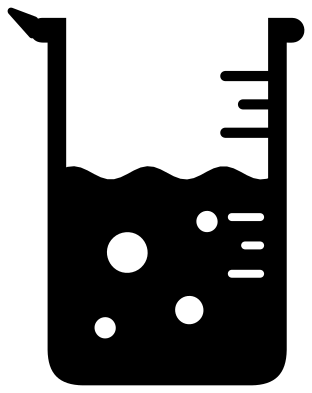 Science beaker with bubbles Solid · one piece
 -
 Science flask, conical Solid · one piece
 -
 Science atom with three orbits Solid · one piece
 -
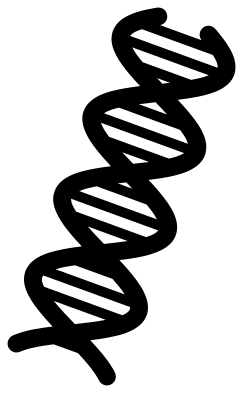 Science DNA double helix Solid · one piece
 -
 Science microscope Solid · one piece
 -
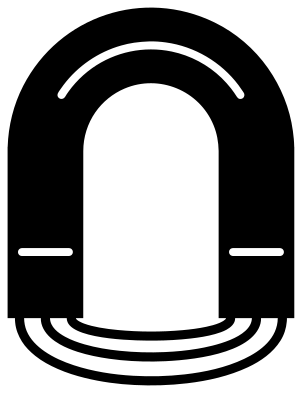 Science horseshoe magnet Solid · one piece
 -
 Science test tubes in a holder Solid · one piece
 -
 Chemistry flask with a molecule Solid · one piece
 -
 Science beaker exploding Solid · one piece
 -
 Science telescope on a tripod Solid · one piece
 -
 Science lab monogram flask Solid · one piece
 -
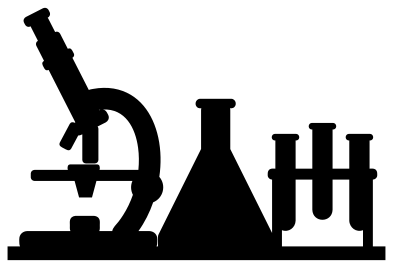 Science lab silhouette on a bench Solid · one piece
 -
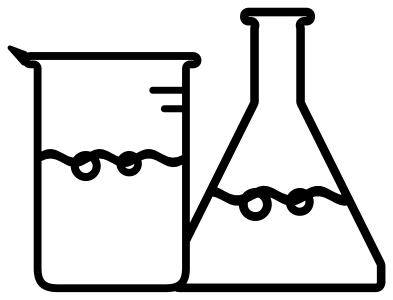 Science beaker and flask outline Outline · one piece
 -
 Layered science flask in five colours Layered · 10 pieces
Glass you can cut
Real laboratory glass is a thin line with nothing inside it, which makes a poor cut file: the outline is fragile and anything drawn inside falls out. Here the glass is a wall between 4 and 5 mm thick when a vessel is 100 mm tall, the liquid is a solid fill joined to that wall, and the bubbles are round holes in the liquid. A beaker or flask cut from one colour of vinyl therefore reads as glass, liquid and bubbles at once.
The scale marks on the beaker are plain ticks with no numbers. Above the liquid they are short bars that stand out from the wall, and below the surface they are cut into the liquid, each between 2 and 3 mm wide. If you want measurements, add them in your cutting software.
Sizes for the finer designs
The atom has orbits about 3 mm wide at 100 mm and is safe in vinyl from about 50 mm across. The DNA helix has rungs about 2.5 mm wide with gaps of the same size, so cut it at 80 mm or more. The field lines of the magnet and the legs of the telescope are the thinnest parts in the set, between 2 and 4 mm, so keep those two at 90 mm or more in card and wood. The lab silhouette stands on a straight bench line and suits a classroom shelf or a shadow box.
How to open the files
- Cricut Design Space: choose Upload, pick the SVG, and add it to the canvas. Set the width you want; the shape is already welded.
- Silhouette Studio: Designer Edition and above open the SVG. The free Basic Edition does not, so open the DXF instead.
- LightBurn, xTool Creative Space and Glowforge: import the SVG, then set the layer to cut, score or engrave.
- Inkscape, Illustrator and Affinity: open the SVG. It is a plain filled path, so you can recolour it, add a stroke or combine it with your own work.
- Printing or sublimation: use the PNG, which has a transparent background.
Each design page lists the file’s narrowest part at seven sizes, so you can tell whether it will survive at the size you plan to cut.
Questions
Will the bubbles fall out when I cut the beaker?
The bubbles are holes, so they are meant to come out: weed each small circle and the colour behind shows through. The smallest are about 5.5 mm across when the beaker is 100 mm tall. Nothing else in the beaker is loose.
How do I put a name in the monogram flask?
The bowl of the flask is an open circle about 65 mm across when the design is 100 mm tall. Set an initial or a short name inside it in your cutting software. Cut the letters from a second colour, or let them touch the wall of the flask and weld them for one piece.
Which science design is best for a teacher gift?
The lab glassware and the atom are the two that everyone recognises, and both fit a tumbler or a tote. For a biology teacher choose the DNA helix or the microscope, and for physics the magnet or the telescope.
 Football SVG
  Baseball SVG
  Softball SVG
  Basketball SVG
  Volleyball SVG
  Soccer ball SVG