Free French curve SVG files
Free French curve SVG files to cut from acrylic, plywood or card: a scroll with three holes, an S, a hooked pattern-cutting curve, a hip curve, a comma, a ship curve and a logarithmic spiral. Each edge is drawn by rule, so its curvature changes smoothly from end to end.
12 designs. Free for personal and commercial use, no sign-up. What you can do with them.
Or choose one below for its PNG, DXF and cutting sizes.
-
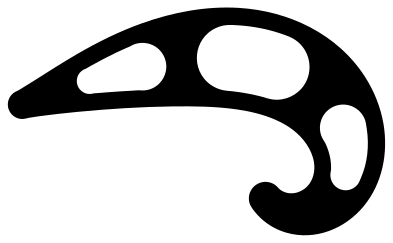 French curve with three holes Solid · one piece
 -
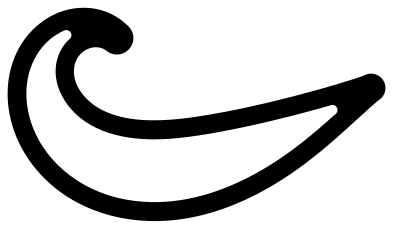 Hollow French curve Solid · one piece
 -
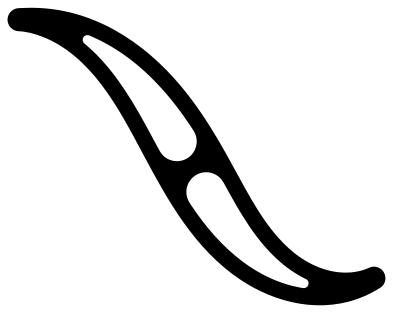 S-shaped French curve Solid · one piece
 -
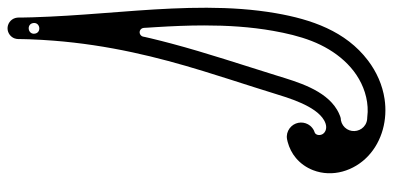 French curve with a hooked end Solid · one piece
 -
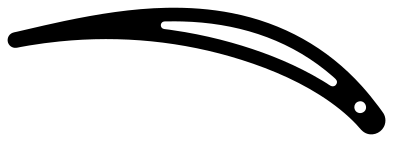 Hip curve, a long French curve Solid · one piece
 -
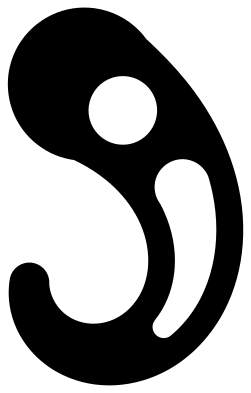 Comma French curve for armholes Solid · one piece
 -
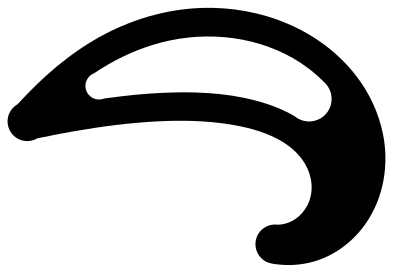 Small French curve for tight radii Solid · one piece
 -
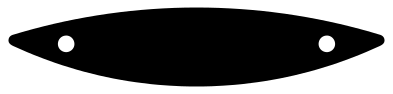 Ship curve, a French curve with two radii Solid · one piece
 -
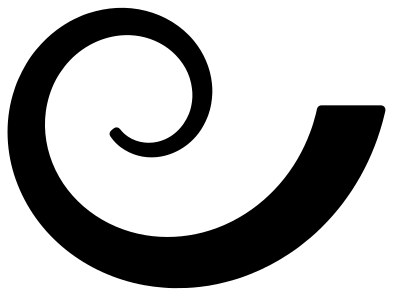 Logarithmic spiral French curve Solid · one piece
 -
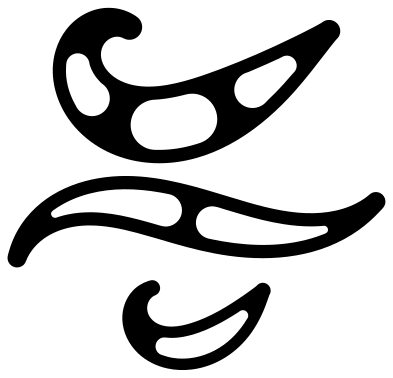 Set of three French curves Solid · 3 pieces
 -
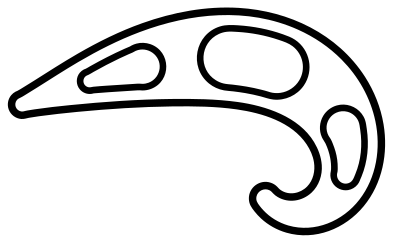 French curve outline Outline · 4 pieces
 -
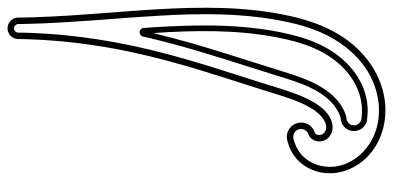 Hooked French curve outline Outline · 2 pieces
What a French curve is, and how these are made
A French curve is a template for drawing smooth curves that are not arcs of a circle. Its edges bend gently at one end and tightly at the other, so somewhere along an edge there is a stretch that fits the curve you want. You mark a few points, turn the template until an edge passes through three of them, draw that stretch, and move on.
These are our own shapes and do not match the numbered sets sold by drafting suppliers. Each is drawn along a spine whose curvature rises evenly along its length, the curve road and railway engineers use to ease into a bend, and given a width that swells and tapers. That makes every edge, inside and out, a curve without flat spots or kinks.
Cutting and using one
Cut them from 2 or 3 mm clear acrylic on a laser, which gives a clean edge to run a pen along and lets you see the drawing underneath. Plywood of 3 mm and stiff card of 400 gsm or more also work for pencil. The files are 100 mm on their longer side: scale the scroll and the S to 200 or 250 mm for drafting, and the hooked curve and the hip curve to 300 mm or more for pattern cutting. Scaling changes the radii in step, so a curve cut twice as long has edges twice as gentle.
How to open the files
- Cricut Design Space: choose Upload, pick the SVG, and add it to the canvas. Set the width you want; the shape is already welded.
- Silhouette Studio: Designer Edition and above open the SVG. The free Basic Edition does not, so open the DXF instead.
- LightBurn, xTool Creative Space and Glowforge: import the SVG, then set the layer to cut, score or engrave.
- Inkscape, Illustrator and Affinity: open the SVG. It is a plain filled path, so you can recolour it, add a stroke or combine it with your own work.
- Printing or sublimation: use the PNG, which has a transparent background.
Each design page lists the file’s narrowest part at seven sizes, so you can tell whether it will survive at the size you plan to cut.
Questions
Do these match a standard French curve set?
No. Commercial sets follow their makers’ own patterns, and these are drawn fresh by rule. They do the same job: any smooth curve can be drawn in short stretches from an edge whose curvature changes steadily, and it does not matter whose template supplies it.
Which French curve do I need for sewing patterns?
The hooked curve and the hip curve. Cut the hooked one about 300 mm long: its blade shapes hems and side seams and its hook shapes necklines and armholes. The hip curve, cut 400 to 500 mm long, draws the long shallow line from waist to hip. The comma handles the tightest armhole and crotch curves.
How do I stop ink smudging under the edge?
Lift the edge off the paper. Stick two or three small pieces of masking tape to the underside of the template, away from the edges, so that ink cannot creep under it, and wipe the edge before you move it.
 Camera SVG
  Guitar SVG
  Music note SVG
  Stethoscope SVG
  Tooth SVG
  Light bulb SVG