Free physical therapy SVG files
Free physical therapy SVG files: a figure stretching on a mat, a lunge silhouette, a resistance band exercise, a therapist treating a patient, a knee joint, a spine, crossed crutches, a goniometer, a wheelchair, a heart and a monogram frame. Plain round figures with no faces, and no lettering.
14 designs. Free for personal and commercial use, no sign-up. What you can do with them.
-
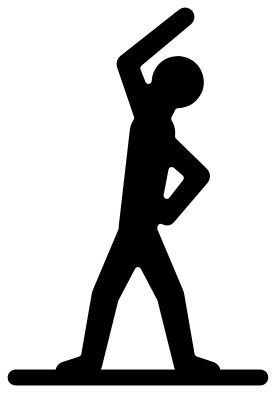 Physical therapy stretch on a mat Solid · one piece
 -
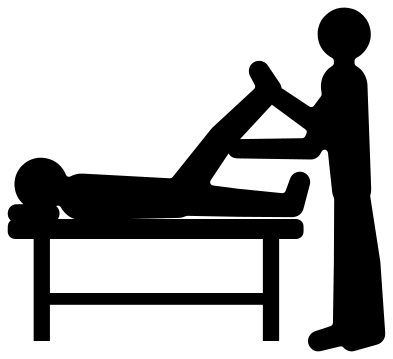 Physical therapist treating a patient Solid · one piece
 -
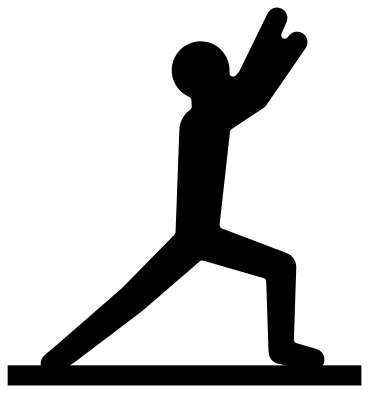 Physical therapy lunge silhouette Solid · one piece
 -
 Physical therapy resistance band exercise Solid · one piece
 -
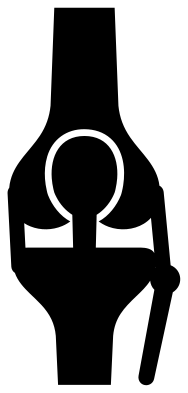 Physical therapy knee joint Solid · one piece
 -
 Physical therapy crutches, crossed Solid · one piece
 -
 Physical therapy patient on crutches Solid · one piece
 -
 Physical therapy goniometer Solid · one piece
 -
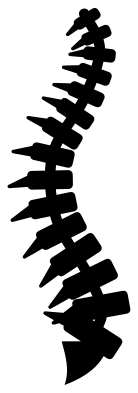 Physical therapy spine Solid · one piece
 -
 Physical therapy wheelchair Solid · one piece
 -
 Physical therapy heart with a reaching figure Solid · one piece
 -
 Physical therapy monogram frame Solid · one piece
 -
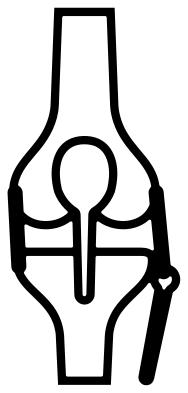 Physical therapy knee outline Outline · one piece
 -
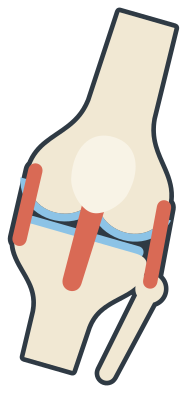 Layered knee joint for physical therapy Layered · 9 pieces
Figures that cut cleanly
The figures are built like signs: a round head, a thick body and limbs with round ends. On the stretch on a mat at 100 mm tall the arms are 5 to 6 mm wide and the legs 5 to 9 mm, with nothing cut inside them, so they weed in seconds and hold in vinyl down to about 35 mm. That makes them good for small things: a water bottle, a clipboard, the corner of an appointment card.
The resistance band is the thinnest part of any figure design, at a little over 2.5 mm when the design is 100 mm tall, and it is joined to both hands and passes under both feet. Cut that one at 70 mm or more. The lunge silhouette stands on a mat with a straight lower edge, so in card or thin plywood it will stand upright in a shadow box.
Anatomy and equipment
The knee joint is drawn from the front and is about 46 mm wide when it is 100 mm tall. The line round the kneecap is a cut a little under 2 mm wide. The spine has fifteen vertebrae, which is fewer than a real one, so that each stays large enough to cut; the gaps between them are about 2 mm and one cord holds them together. The goniometer has tick marks but no numbers, which keeps it cuttable and lets you add your own.
How to open the files
- Cricut Design Space: choose Upload, pick the SVG, and add it to the canvas. Set the width you want; the shape is already welded.
- Silhouette Studio: Designer Edition and above open the SVG. The free Basic Edition does not, so open the DXF instead.
- LightBurn, xTool Creative Space and Glowforge: import the SVG, then set the layer to cut, score or engrave.
- Inkscape, Illustrator and Affinity: open the SVG. It is a plain filled path, so you can recolour it, add a stroke or combine it with your own work.
- Printing or sublimation: use the PNG, which has a transparent background.
Each design page lists the file’s narrowest part at seven sizes, so you can tell whether it will survive at the size you plan to cut.
Questions
Which physical therapy design works best small?
The stretch on a mat, the lunge silhouette and the heart. They are solid shapes with round ends and nothing fine inside, so they cut cleanly at 30 to 40 mm. The spine, the wheelchair and the knee joint have narrow parts and are better at 80 mm or more.
Is the knee joint accurate enough for teaching?
It shows the right parts in the right places: the thigh bone, the shin bone, the slim outer bone of the lower leg, a ligament down each side and the kneecap on its tendon. It is simplified for cutting, so use it for labels, colouring and gifts and not as a clinical diagram.
Can I add a clinic name to the monogram frame?
Yes. The ring is open in the middle and about 60 mm across when the frame is 100 mm tall. Set initials or a short name inside it in your cutting software, and weld the letters to the ring if you want one piece.
 Camera SVG
  Guitar SVG
  Music note SVG
  Stethoscope SVG
  Tooth SVG
  Light bulb SVG