Free bingo SVG files
Free bingo SVG files for the 75-ball game: a blank card with a free star, a card with numbers, a winning diagonal, single balls and sets of them, an ink dauber, the cage on its stand and a header strip. Every number sits in the column the rules give it.
12 designs. Free for personal and commercial use, no sign-up. What you can do with them.
Or choose one below for its PNG, DXF and cutting sizes.
-
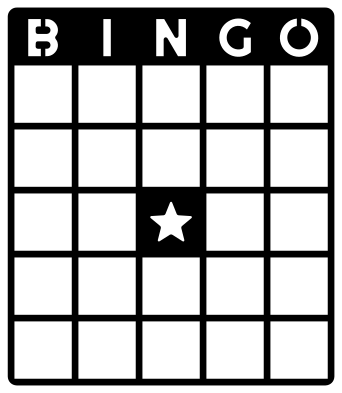 Blank bingo card with a star in the middle Solid · one piece
 -
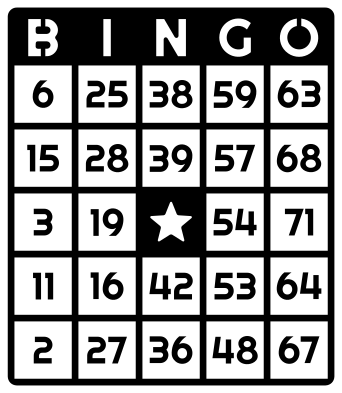 Bingo card with numbers in every column Solid · 46 pieces
 -
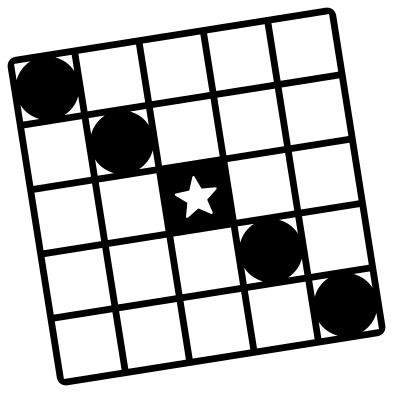 Bingo card with a winning diagonal Solid · one piece
 -
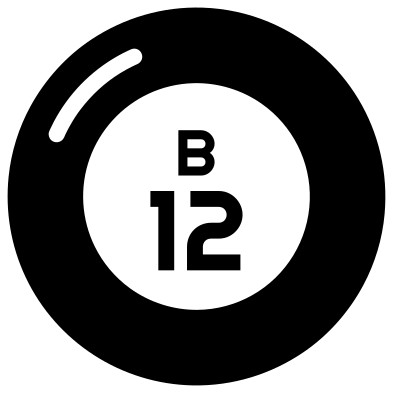 Bingo ball B 12 Solid · 4 pieces
 -
 Five bingo balls spelling the word Solid · 10 pieces
 -
 Three bingo balls in a pile Solid · 9 pieces
 -
 Bingo dauber with three marks Solid · 4 pieces
 -
 Bingo cage silhouette with balls Solid · one piece
 -
 Bingo header strip with five letters Solid · one piece
 -
 Bingo ball with a crown Solid · 4 pieces
 -
 Bingo ball outline Outline · 5 pieces
 -
 Layered bingo ball in three colours Layered · 6 pieces
What goes in each column
A 75-ball card has five columns under the letters B, I, N, G and O, five squares in each, and the square in the middle is free, which leaves 24 numbers. Each column draws from its own fifteen: B from 1 to 15, I from 16 to 30, N from 31 to 45, G from 46 to 60 and O from 61 to 75, and no number appears twice on a card. The numbered card and every ball here follow that, so B 12, I 22, N 38, G 52 and O 66 are balls that exist and B 40 is not.
The blank card is the one to use for a party game of your own. Its squares are empty, so you can write in baby shower gifts, road trip sights or spelling words. Cut the card from vinyl and stick it to a dry-wipe board, or cut it from card and write on the paper behind it.
Sizes and loose pieces
The card is 100 mm tall as drawn, with squares about 15 mm across and lines 1.8 mm wide. At 200 mm tall the squares are 31 mm, which takes a short word or a sticker. The card itself is one piece. Numerals and the lettering in the windows of the balls are loose, as they must be to read as dark figures on a light ground, so lift those with transfer tape. On a laser, engrave the numerals and cut only the outline of the ball.
How to open the files
- Cricut Design Space: choose Upload, pick the SVG, and add it to the canvas. Set the width you want; the shape is already welded.
- Silhouette Studio: Designer Edition and above open the SVG. The free Basic Edition does not, so open the DXF instead.
- LightBurn, xTool Creative Space and Glowforge: import the SVG, then set the layer to cut, score or engrave.
- Inkscape, Illustrator and Affinity: open the SVG. It is a plain filled path, so you can recolour it, add a stroke or combine it with your own work.
- Printing or sublimation: use the PNG, which has a transparent background.
Each design page lists the file’s narrowest part at seven sizes, so you can tell whether it will survive at the size you plan to cut.
Questions
Which numbers go under each letter on a bingo card?
B takes 1 to 15, I takes 16 to 30, N takes 31 to 45, G takes 46 to 60 and O takes 61 to 75. Each column has five squares, so it shows five of its fifteen numbers, except N, which shows four because the middle square is free.
How do I make my own numbers for the blank card?
For each column, pick five different numbers from that column’s range and set them in any order, leaving the centre free. Type them in your cutting software in a plain bold face about half the height of a square, or write them by hand on the layer behind the card.
Can I cut the bingo balls as one piece?
The disc of each ball is one piece with a round window. The letter and number sit inside the window as separate pieces, so on vinyl you move the ball and its lettering together with transfer tape. For wood or acrylic, cut the disc and engrave or paint the lettering on a lighter disc glued behind the window.
 Crown SVG
  Banner SVG
  Bow SVG
  Gift tag SVG
 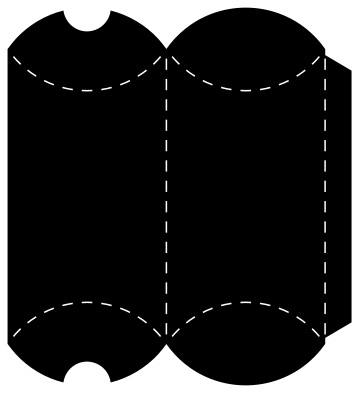 Pillow box SVG
 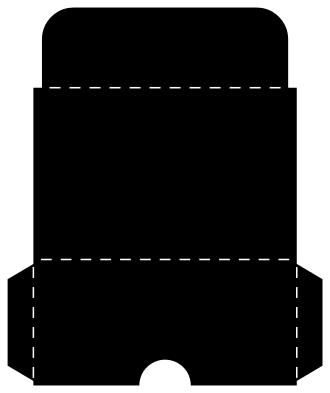 Gift card holder SVG