Free Polish paper cutting patterns
Free Polish paper cutting patterns in the manner of wycinanki, the folk paper cuts of Poland: three round stars, a tree with two roosters, pairs of roosters and peacocks, a forest and a plant in a pot, each one sheet that holds together, and four layered designs in bright colours on a dark base. All drawn by code, as SVG, PNG and DXF.
13 designs. Free for personal and commercial use, no sign-up. What you can do with them.
Or choose one below for its PNG, DXF and cutting sizes.
-
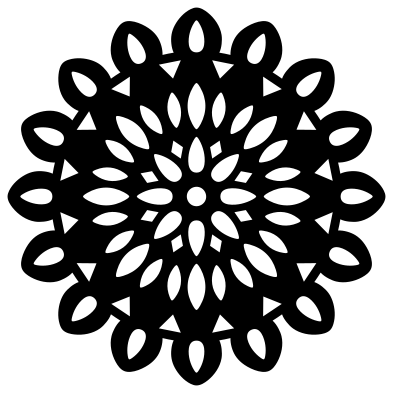 Round Polish paper cutting star Solid · one piece
 -
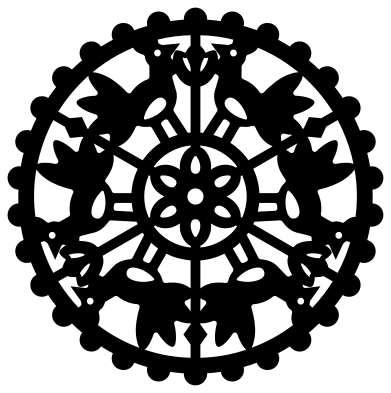 Polish paper cut star with six roosters Solid · one piece
 -
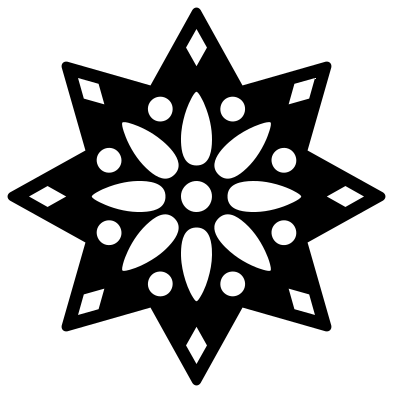 Easy Polish paper cutting star Solid · one piece
 -
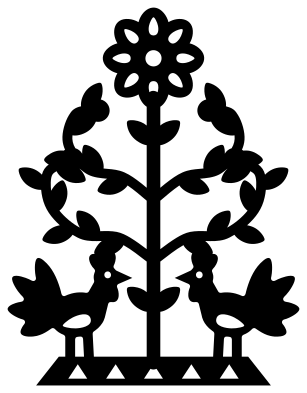 Polish paper cutting tree with two roosters Solid · one piece
 -
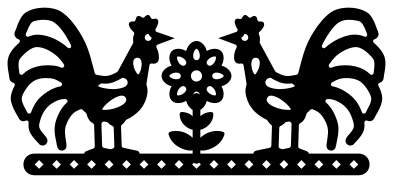 Polish paper cutting of two roosters and a flower Solid · one piece
 -
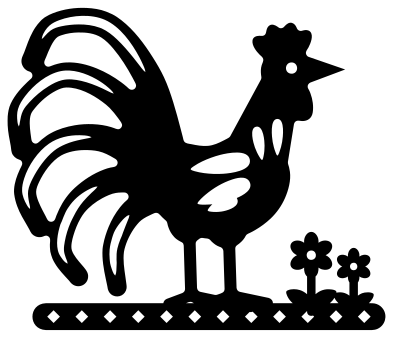 Polish paper cut rooster Solid · one piece
 -
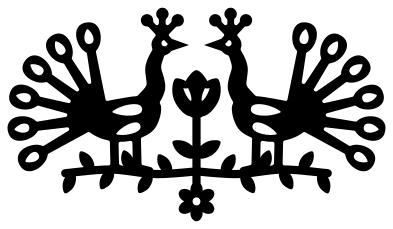 Polish paper cutting of two peacocks Solid · one piece
 -
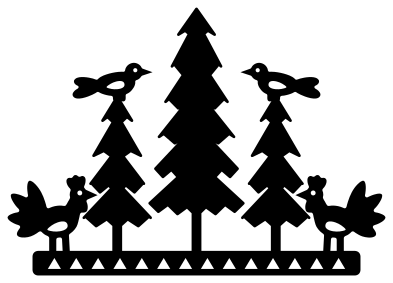 Polish paper cut forest with birds Solid · one piece
 -
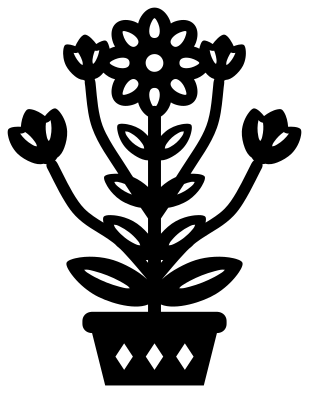 Polish paper cutting of a flowering plant in a pot Solid · one piece
 -
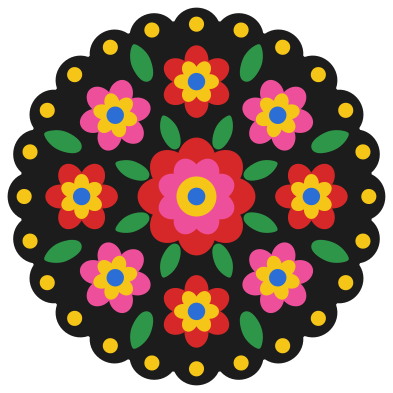 Layered Polish paper art star of flowers Layered · 69 pieces
 -
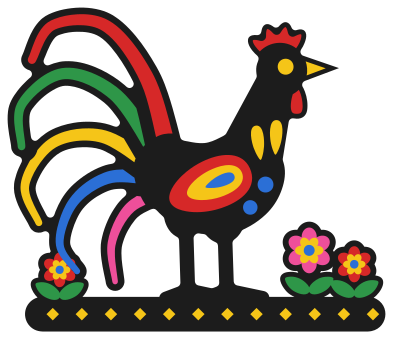 Layered Polish paper cutting art rooster Layered · 40 pieces
 -
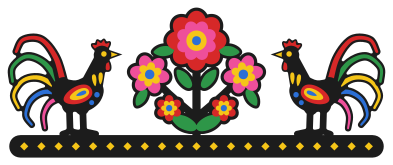 Layered Polish paper cut band with roosters Layered · 77 pieces
 -
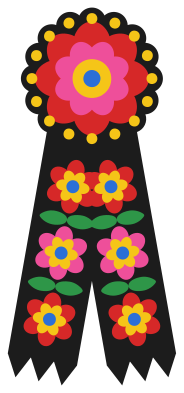 Layered Polish paper cut ribbons Layered · 45 pieces
What wycinanki are, and what these patterns are
Wycinanki are the folk paper cuts of Poland: decorations cut from coloured paper, most often with scissors, and pasted on the walls and ceiling beams of country houses before Christmas, Easter and family occasions. Two regions are especially well known for them. In Kurpie the cuts are a single colour and symmetrical: round stars called gwiazdy, a tree-like form called the leluja, and the forest. Around Łowicz they are many-coloured, built from small pieces of paper glued one on another: round stars, long bands called kodry, and tasiemki, a pair of ribbons joined at the top by a disc. Roosters, peacocks and flowers appear in both.
The patterns here are new drawings made by code in the manner of those two schools. They are not copies or tracings of historic pieces or of any maker’s work, and the notes say only what is drawn, leaving the meanings of the motifs to people who know the tradition. Nine are one colour and one sheet. Four are layered: a dark base and five colours to stack on it.
Paper, size and cutting
Every file is 100 mm on its longer side, and each pattern page lists the narrowest strip of paper at that size. Across the one-colour patterns it runs from 1.4 mm on the single rooster to 2.3 mm on the tree with two roosters. For a cutting machine, paper of 80 to 120 gsm on a light-grip mat with a sharp blade works well, at 150 mm or more for anything with birds in it. To cut by hand, print the PNG on the back of coloured paper and cut the small holes first and the outline last.
For the layered patterns, cut each layer from its own colour: the base in black or another dark paper, then green, red, pink, yellow and blue. Glue them on in that order, since a later colour always sits on an earlier one. On the star of flowers the smallest pieces are about 4 mm across at 100 mm, so 200 mm or more is kinder to the fingers, and the band with roosters wants 250 mm.
How to open the files
- Cricut Design Space: choose Upload, pick the SVG, and add it to the canvas. Set the width you want; the shape is already welded.
- Silhouette Studio: Designer Edition and above open the SVG. The free Basic Edition does not, so open the DXF instead.
- LightBurn, xTool Creative Space and Glowforge: import the SVG, then set the layer to cut, score or engrave.
- Inkscape, Illustrator and Affinity: open the SVG. It is a plain filled path, so you can recolour it, add a stroke or combine it with your own work.
- Printing or sublimation: use the PNG, which has a transparent background.
Each design page lists the file’s narrowest part at seven sizes, so you can tell whether it will survive at the size you plan to cut.
Questions
Which Polish paper cutting pattern is easiest?
The easy star. It has 25 cut-outs, all bold, and no strip of paper narrower than 1.9 mm at 100 mm. Fold a square in half three times into a wedge, draw one eighth of the star on it and cut through all eight layers, or let a machine cut it flat.
Can I fold the paper and cut these by hand, as the Kurpie cuts are made?
Yes, the one-colour patterns that are the same on both sides are made for it. The tree, the two roosters, the peacocks, the forest and the plant in a pot fold once down the middle: draw half against the fold. The round star and the easy star repeat eight times, so fold a square in half three times. The star with six roosters needs a sheet folded in half and then in thirds, like a paper snowflake.
What colours should I use?
For the one-colour patterns, any single strong colour on a white or pale background: the Kurpie cuts are one colour. For the layered patterns the files are drawn in red, pink, yellow, blue and green on a black base, which is close to the bright palette the Łowicz cuts are known for, but the layers are separate, so you can change any of them.
 Turkey SVG
  Easter egg SVG
  Firework SVG
  Mardi Gras mask SVG
  Valentine card SVG
  Mother’s Day card SVG